
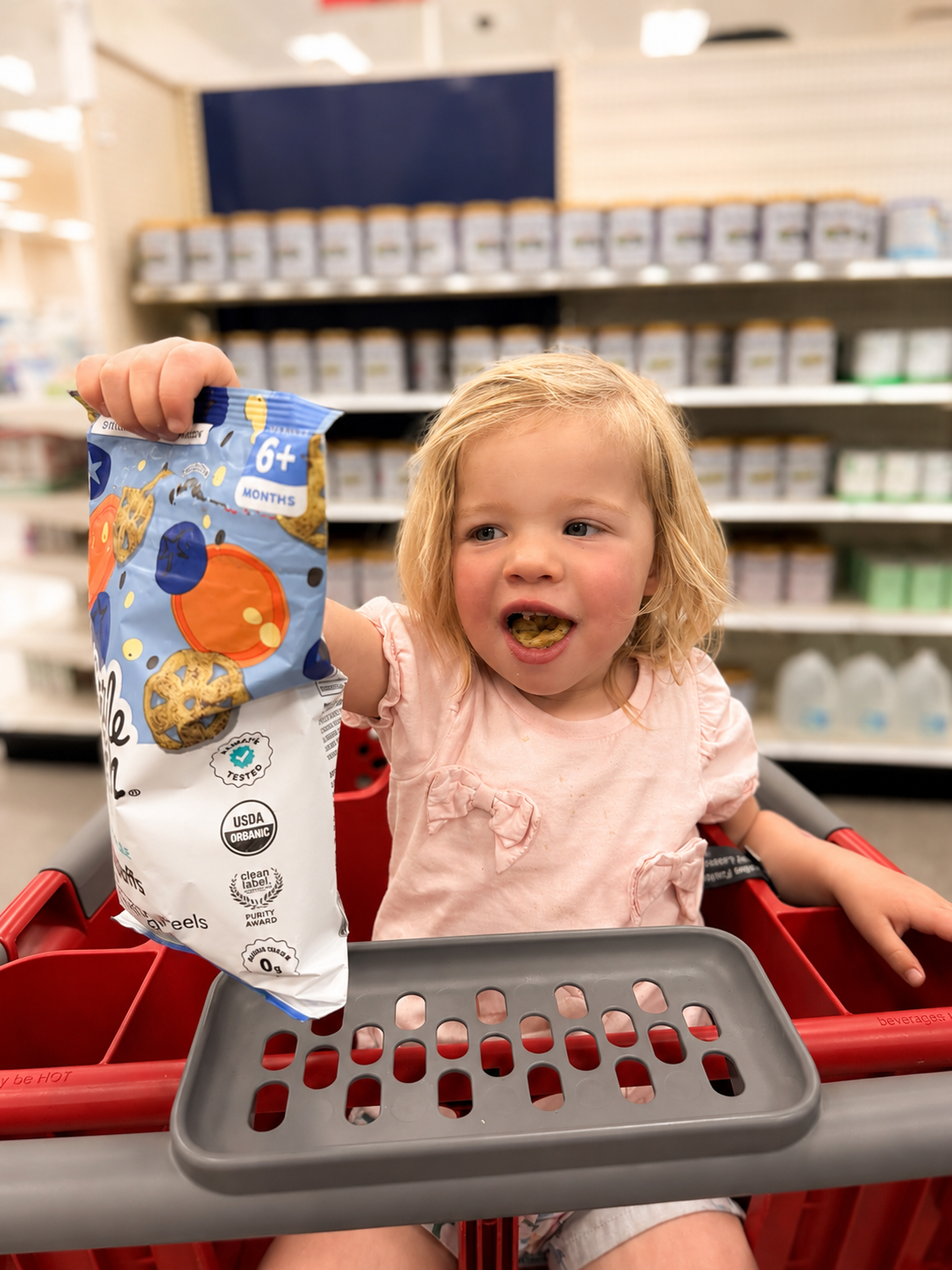
A two-minute read for the parent standing in the aisle with a toddler on her hip and approximately four minutes until someone melts down.
If you have spent any time in the baby aisle in the last six months, you have probably seen a headline like "70% of baby foods are ultra-processed" and felt something tighten in your chest. I have been there. I am there most weeks.
And honestly, I wanted to know whether this was real, internet panic, or somewhere annoyingly in the middle.
So I went down the rabbit hole for you.
Here is the version I wish someone had handed me in the aisle instead of twelve tabs and a guilt spiral. What actually changed in 2025 and 2026 in how pediatric medicine talks about ultra-processed food for kids, what the new research actually found, and the three things I personally look at on a baby food label when I am holding a pouch in one hand and a kid in the other.
This is not a panic post. Most baby food on the shelf is fine. Some of it is more engineered than most parents realize. And once you know what to look for, you usually do not need more than thirty seconds to make a decision.
Because this is not about becoming the kind of parent who mills her own oats at 10 PM.
What changed in late 2025 and early 2026
Two things, both worth knowing about.
First, in November 2025, the American Academy of Pediatrics released its first formal policy roadmap on ultra-processed foods in children's diets. It is called Decreasing Children's Consumption of Ultraprocessed Foods: A Policy Roadmap, published in Pediatrics Open Science by Drs. Cataltepe and Virudachalam.
This was a meaningful shift. The AAP, the medical body that sets pediatric standards in the U.S., officially put ultra-processed food reduction on the pediatric record as something worth paying attention to.
One number from the roadmap stood out: ultra-processed foods account for roughly 67% of total energy intake in U.S. children.
Which honestly makes sense if you have ever tried grocery shopping with two kids and exactly eleven minutes before nap meltdown.
What the roadmap does not do matters too. It does not rank specific products, ban ingredients, or tell you your pediatrician is wrong. It frames a category, not a verdict.
Second, in February 2026, a study analyzed 651 baby and toddler foods sold across the ten largest U.S. grocery chains and found that 71% met the criteria for ultra-processed. This is the headline most people saw circulating online.
The study, published in Nutrients by researchers from The George Institute for Global Health and UNC Gillings, found two things that are actually useful for parents standing in an aisle:
- Ultra-processed baby foods contained about twice the sugar of non-ultra-processed equivalents.
- Added sugars appeared only in the ultra-processed products.
Researchers also found that a handful of additive categories carried most of the load: added sugars under multiple names, gums and emulsifiers, synthetic flavor enhancers, synthetic colors, and higher-sodium toddler snack formulations.
That does not mean every pouch is dangerous.
It does mean the average baby aisle is more engineered than most parents realize.
And like most nutrition research, this study is a shelf snapshot, not a verdict on your actual kitchen.
So what does "ultra-processed" actually mean
Researchers use something called the NOVA framework, which sorts foods into four categories, from minimally processed (an apple) to ultra-processed (industrial formulations built from refined ingredients and additives).
In plain language, ultra-processed foods are usually products made with ingredients you would not typically use in a home kitchen, often designed to extend shelf life, intensify flavor, or create a very specific texture.
That distinction matters more than most Instagram conversations make it sound.
Because some foods that look "processed" are barely processed at all. Frozen vegetables? Fine. Plain yogurt? Fine. A shelf-stable strawberry yogurt bite containing twelve ingredients and three sweeteners? Different conversation.
The framework matters.
Frozen peas are not the enemy.
One more important nuance. The 2025–2030 Dietary Guidelines Advisory Committee declined to formally adopt ultra-processed food terminology in this round of federal dietary guidance. So the strongest medical-body anchor here is currently the AAP roadmap, not the federal guidelines.
Knowing what research does not say matters too.
The three things I look at on a baby food label, in order
This is the same framework I put in the downloadable guide below. Not a list of "good" brands. Just the quickest way I know to cut through the noise without needing a chemistry degree in Target.
Real food usually has short labels.
The ingredients you would realistically cook with at home — fruit, vegetables, oats, olive oil, whole grains — should generally show up near the top.
FDA rules require ingredients to be listed in descending order by weight, so the first ingredient is what makes up most of the product.
If the ingredient list reads longer than the recipe I would realistically make on a Tuesday, I pause there first.
And if I cannot pronounce three ingredients in a row, that is information too.
Not necessarily a verdict. Just information.
Because compound terms like "natural flavors" can still hide multiple ingredients underneath them. But overall, length plus ingredient naming is one of the cleanest non-obsessive cues parents can use quickly.
Added sugar is not only the word "sugar."
It is also:
- cane sugar
- evaporated cane juice
- brown rice syrup
- corn syrup
- maltodextrin
- fruit juice concentrate
If one of those lands in the first few ingredients of a baby or toddler snack, I usually put it back.
This is also the cue with the strongest evidence anchor in the February 2026 study. Added sugars appeared only in the ultra-processed products researchers analyzed.
Fruit puree near the top of an ingredient list is different. That is the food itself, not necessarily an added sweetener.
This is where nuance matters.
Not every sweet-tasting baby food is automatically a problem. The question is usually: what is creating the sweetness, and how engineered is it?
You do not need to feed your child perfectly to materially improve what they eat.
Heavy metals are a separate issue from ultra-processing and additives, but they matter most in a few common infant-food categories:
- rice cereal
- fruit purees
- root-vegetable purees like carrot and sweet potato
In January 2025, the FDA finalized updated guidance under its Closer to Zero action plan establishing voluntary lead action levels for several baby food categories.
Voluntary means brands can choose to publicly show their testing and sourcing standards.
That matters.
As of January 2026, Virginia and Maryland require baby food manufacturers to publish heavy-metal testing information through QR codes on packaging. California has had a version of this in effect since January 2025.
If you live in one of those states, scan it once.
If the company makes the information easy to find, that is useful information. If the QR code dead-ends into a marketing page and three newsletters, that is also useful information.
This is a thirty-second aisle decision, not a master's thesis.
What lives in our house
A short rotation.
Pouches when we are in the car. Whole foods at the table when I have ten minutes. Frozen waffles occasionally because life is happening. Snacks pulled from the diaper bag at questionable temperatures. All of it.
Some weeks the meals are beautiful.
Some weeks it is a granola bar in the car seat at 4:47 PM because we are late and someone is crying.
Both happen.
There is no version of this where you have to perform feeding to do it right.
There is only paying attention to the things that actually matter, improving what you reasonably can, and letting go of the parts that mostly exist to make parents feel like they are failing.
I intentionally do not list specific brand names in this piece. The point is the cues, not the shelf.
The shelf changes. The cues do not.
Two things to keep, and one thing to ignore
To keep:
One. The AAP formally put ultra-processed foods on the pediatric conversation map in late 2025. The February 2026 grocery-chain study reinforced that a large percentage of baby and toddler foods on shelves currently meet ultra-processed criteria. Both are worth knowing about.
Two. Ingredient simplicity, added-sugar positioning, and transparency around heavy-metal testing are still the fastest, least obsessive tools most parents can use in real life.
No spreadsheets required.
To ignore:
The wave of all baby food is poison content this news cycle is generating online.
That is not what the research says. It is not what the AAP says. And it is definitely not useful at 5 PM.
Discernment is the lane. Panic is not.
If your pediatrician or a registered dietitian has given you guidance specific to your child — allergies, growth concerns, medical conditions, anything else — that overrides this piece every time. They know your kid. I am writing this for the everyday "is this probably fine" question, not the "my doctor said" question.
For your back pocket
If you want the cues with you in the aisle, I made a free one-page guide called Baby Food, Decided. Three cues. No brand rankings. Made for the aisle.
I built it because I kept reading baby food content that either wanted me to buy a twelve-dollar jar or make everything from scratch.
Most real kitchens look like neither.
This is for the in-between.
Welcome. Glad you are here.
— Anastasia
Well, Mostly
This piece is information, not medical advice. I am a board-certified health coach (NBHWC, exam July 2026), not a physician. If anything specific to your child is concerning you, please bring it to a clinician you trust.
Sources: Cataltepe D, Virudachalam S. Decreasing Children's Consumption of Ultraprocessed Foods: A Policy Roadmap. Pediatrics Open Science, Vol 1 Issue 4, November 2025 (American Academy of Pediatrics). Dunford EK, Pries A, Calvo MS, Coyle DH. Ultra-processed and discretionary food and beverage products marketed for infants and toddlers in the United States. Nutrients, February 11, 2026 (n=651, ten large U.S. grocery chains; The George Institute for Global Health and UNC Gillings Global School of Public Health). U.S. Food and Drug Administration, Closer to Zero action plan (active 2021–present); January 2025 final guidance on action levels for lead in baby food categories. California AB 899 (effective January 1, 2025); Virginia HB 1413 (effective January 1, 2026); Maryland SB 723 (effective January 1, 2026). NHANES-derived dietary intake analyses summarized within the AAP November 2025 roadmap.
