
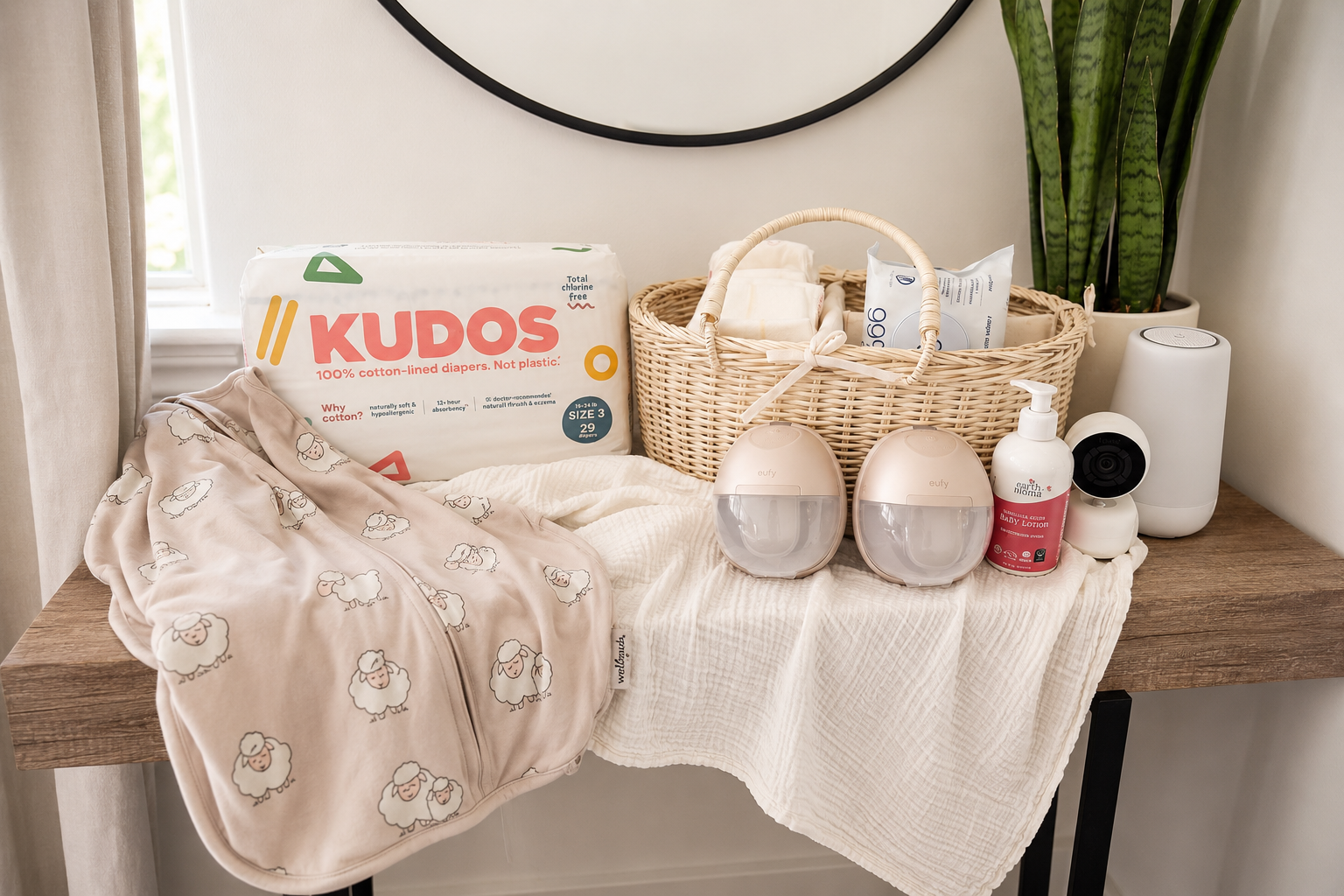
No overwhelm. Just what works.
In this guide: Sleep · Diapering · Feeding · On-the-go · Postpartum · Play
When I was pregnant with my first daughter, I did what most first-time moms do. I opened a registry, stared at hundreds of options for every single item, and had no idea where to start.
So I built a spreadsheet. Then another one. Then I became the person my friends text when they get pregnant, asking what I actually used, what I'd skip, and what was worth the money.
This guide is that spreadsheet: organized, edited down, and honest. It covers everything from the crib to the carrier to the things nobody tells you you'll need at 3am. Where I have a strong opinion, I'll share it. Where I did deeper research, especially for the products your baby is in contact with most, I'll explain why it mattered to me. And where I started with the best intentions and reality intervened, I'll tell you that too.
My second daughter inherited a collection of loud plastic toys that light up and play the same four notes on repeat. They don't have a single certification on them. She loves them. They stay.
This is not about creating a perfectly curated, toxin-free home. It's about knowing what's worth the research, what's worth the splurge, and what just needs to work.
I'm a certified health coach and a mom of two, eighteen months apart, fully in the thick of it. These are the products that have worked for my family, not a prescription for yours. Take what resonates. Leave what doesn't.
Why I bothered to research any of this
Our bodies are designed to filter what we're exposed to. That's what the liver, kidneys, and lymphatic system do. But for a newborn, those systems are still developing. An infant's brain is growing at a pace it will never reach again, their organs are immature, and their skin absorbs more relative to body size than ours does.
When a baby is constantly surrounded by products that off-gas, contain hormone-disrupting chemicals, or are treated with flame retardants, it creates a load on a system that isn't fully ready for it.
The goal isn't elimination. The goal is reduction.
Making thoughtful choices in the places that matter most lets your baby's body focus on growing instead of filtering.
If you do nothing else
You do not need to overhaul everything. Perfection is not the goal and never was.
If I had to give one piece of advice, it would be this:
Focus on where your baby spends the most time.
For most babies, that's the crib and the car seat. Start there. Everything else can happen gradually.
Sleep
Sleep is the single highest-impact category. Your baby will spend more time here than anywhere else, which is exactly why I'd start here if I were doing it again.
100% certified organic materials. Meets safety standards without chemical flame retardants. One of the few products where the certifications actually matched the claims. This is where I chose to invest, because of how many hours babies spend here.
Merino wool regulates temperature naturally, which means one sleep sack works year-round. Sizing runs 2–24 months, so you actually use it long-term. Removes the guesswork of what to dress them in. One of the few products I used consistently with both kids.
A note on flame retardants
In the U.S., baby mattresses and sleepwear are required to meet flammability standards. Most brands meet this with chemical flame retardants, a category that includes some of the most well-documented endocrine disruptors in consumer products.
Wool is naturally flame resistant, which means products that use a wool barrier can meet safety standards without added chemical treatment. This is why brands like Naturepedic use wool in their mattresses, and why some baby sleepwear is made from merino wool. It meets the standard naturally.
If a product claims to be "flame retardant free," it's worth understanding how it meets the requirement. If they can't tell you, that's something I pay attention to.
Full sleep setup, including sheets and backups, is in the guide.
Diapering
You'll interact with this category constantly, so performance matters more than anything else.
Incredibly soft, hold overnight better than anything else we tried, and consistently reliable.
Baby's skin touches 100% cotton instead of plastic. A solid alternative if materials are your priority.
Full diapering breakdown, including wipes and creams, is in the guide.
Want the full list?
I put everything into one place: all 146 items, broken down by category with the same kind of notes you see here, plus a lot of detail I didn't include in this post.
It's the exact guide I wish I'd had the first time around.
Download the guide →Feeding
bottle + breast
Whether you're breastfeeding, bottle feeding, or doing a mix, simplicity matters more than perfection here.
The only wearable that actually worked well for me. The heating feature helped with milk flow, it didn't leak, and the charging case made it easy to use consistently.
Both of my babies took them easily. The glass option reduces plastic use, and our lactation consultant recommended them.
Easy to use daily, grows with your child, and looks like furniture instead of plastic.
Cleaning, accessories, and backups are in the guide.
On-the-go
This is where you make life easier. Or much harder.
The 360 rotation is a game changer. You can adjust instantly based on sun or toddler preference. Caveats: it's heavy, the double configuration isn't great, and it's a splurge.
Instantly replaces unsupported hip carrying. My back noticed the difference immediately. Pockets for everything. One of those products that feels optional until you use it. I keep one in the car at all times.
Full on-the-go setup is in the guide.
Postpartum
for you
Most guides skip this. This is the section I'd tell any mom to pay closest attention to.
Real support after my C-section. Adjustable compression. Reduced the pulling feeling when moving.
Simple upgrade that makes a real difference. The angled design is much easier to use than the alternative.
Full postpartum setup is in the guide.
Play & development
Babies don't need much. But a few well-designed things go a long way.
Holds attention longer than almost anything else. Helped with tummy time and crawling. Both kids used it. If I had to buy one toy again, this would be it.
Engaging visuals, a simple format babies love, and something we've kept adding to. Current favorite: You're My Little Cookie Monster.
More play ideas in the guide.
If you're building a registry
I put everything into one guide so you don't have to piece it together yourself: the full product list, category breakdowns, and everything I'd buy again, plus what I wouldn't.
Download the full guide →You don't need to get this perfect.
You just need it to work for your life.
Some of the links in this guide are affiliate links, which means I may earn a small commission if you buy through them. I only recommend products I've actually used with my own kids. It doesn't change the price for you.
As an Amazon Associate I earn from qualifying purchases.
